

Creatine: An Evidence Based Guide
Creatine is everywhere, in the gym, across social media, in fitness conversations, and for good reason. As a Registered Dietitian, it's the #1 supplement I recommend to my high school clients all the way up to my elderly clients.
Here’s why creatine is a game-changer for performance, recovery, and neurological health.
As one of the most studied and well-researched supplements on the market, creatine is proven to enhance performance, fuel muscles, and support recovery. It has become a staple supplement for athletes and active individuals of all ages and abilities, offering benefits from improved strength and endurance, to faster recovery after intense activity, and even neurological improvements.
This blog will break down how creatine works, its performance and recovery benefits, supplementation strategies, and considerations for different populations, while debunking a few myths along the way to help you understand why this supplement has become a staple in performance nutrition
What is Creatine and how does it work?
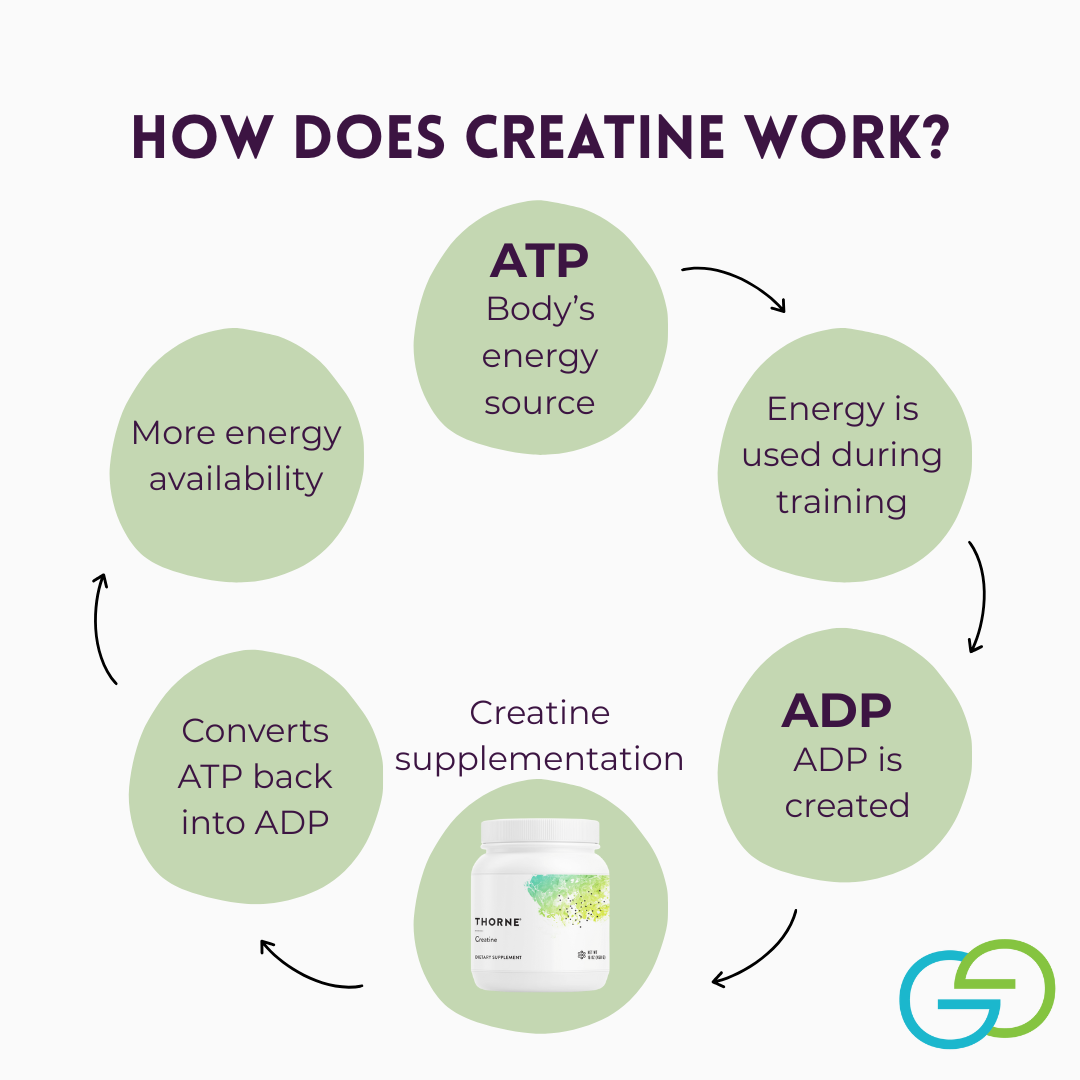
Creatine is a naturally occurring compound found primarily in your muscles, where it plays a critical role in producing energy for high-intensity, short-duration activities such as sprinting, jumping, or lifting. During these types of movements, your muscles rely on the ATP-PCr (adenosine triphosphate–phosphocreatine) system for rapid energy. Phosphocreatine donates a phosphate to ADP to quickly regenerate ATP, which is the molecule your muscles use for immediate energy.
By supplementing with creatine, you increase the amount of phosphocreatine stored in your muscles. This allows your muscles to generate ATP more efficiently, enabling you to perform more repetitions, lift heavier weights, or maintain sprint performance for longer. Over time, this improved energy availability can contribute to increases in strength, power, and muscle size.
Beyond performance during exercise, creatine may also help support recovery. Research suggests it can aid in replenishing energy stores after intense activity, reduce muscle fatigue, and even assist with recovery after injury or periods of muscle overuse. This combination of performance and recovery benefits makes creatine a versatile tool for athletes and active individuals.
Creatine and Muscle Recovery
Even when your muscles are not working at full capacity, such as during injury, immobilization, or a period of downtime, they can lose strength and energy. Research shows that muscle disuse can reduce energy stores in the muscle and trigger stress at the cellular level, which contributes to muscle loss and slower recovery (Wax et al., 2021). Creatine may help counteract some of these effects. By boosting creatine and phosphocreatine (PCr) levels in your muscles, it helps keep the energy system running efficiently during rehab exercises. This means you may be able to do more reps or train at a higher intensity, which can help minimize muscle loss and speed up recovery (Wax et al., 2021).
There may be other ways creatine supports recovery as well. Higher creatine levels in the muscle can cause cells to swell slightly, which can trigger muscle-building signals even without exercise (Wax et al., 2021). Creatine also appears to boost protein-building factors like IGF-1 and 4E-BP1, which can help repair and rebuild muscle after resistance training (Wax et al., 2021).
It is worth noting that the benefits are different for everyone. Some studies show creatine can help prevent muscle loss in the arms during short-term immobilization, but the effects are less consistent for legs, knee surgery, or ACL recovery (Wax et al., 2021). Still, the evidence suggests creatine can be a helpful part of a recovery plan when combined with rehab and strength training.
Performance Benefits of Creatine
Research consistently shows improvements in maximal strength, power output, and total work performed during resistance training with creatine supplementation. These benefits occur during both single maximal efforts and repeated sets, making creatine especially useful for weightlifting, sprinting, jumping, and explosive sport movements (Wax et al., 2021). Creatine has also been shown to improve repeated sprint performance and may enhance agility and jumping ability. Athletes involved in sports that require frequent bursts of speed with short recovery periods may see meaningful benefits. Some evidence also suggests creatine may support certain types of high-intensity endurance exercise by improving physiological efficiency (Wax et al., 2021).
To continue, these benefits are not just limited to elite athletes. Recreationally active individuals, older adults, menopausal females, and those returning to exercise after a period of reduced activity all can benefit from creatine supplementation. Individuals following plant-based diets may experience larger increases in muscle creatine due to lower baseline levels, though performance benefits are proven to be similar across dietary patterns (Wax et al., 2021).
Creatine Supplementation in Older Individuals and Postmenopausal Women
Research on creatine in the past 10-15 years has highlighted the neurological health benefits in older individuals as well. Consistent creatine supplementation has been proven to increase the ability to perform activities of daily living, delay fatigue, and improve muscle mass for older populations.
Older Individuals
Creatine supplementation has been shown to be effective for both males and females across the lifespan, including older adults. Women respond similarly to men in terms of increased muscle creatine stores and improvements in strength and high-intensity performance. For older adults, creatine can be beneficial due to age-related sarcopenia, which is an overall decline in muscle mass, strength, and power. Consistent supplementation paired with resistance/strength training can enhance lean muscle mass gains and increase strength and functional capacity.
Creatine has also shown promise in supporting neurological health. Studies indicate that it may help reduce brain fatigue and improve cognitive performance, particularly in older adults, who may experience age-related cognitive decline. Overall, these improvements may translate to better balance, mobility, and overall quality of life (Xu et al., 2024).
Postmenopausal Women
Creatine has been formerly misunderstood as a “male” supplement, but this is simply false. Research has consistently shown that benefits of creatine supplementation in females exceed beyond muscle enhancement. It plays a key role in improving cellular hydration, which enhances calcium kinetics, a crucial factor for maintaining bone health. By increasing intracellular water retention, creatine may help preserve bone mineral density by supporting the mechanical loading of bone through muscle contractions. This becomes especially important as estrogen levels decline after menopause, a time when the risk of osteoporosis and bone fractures increases (Smith-Ryan et al., 2025).
Moreover, creatine helps preserve fast-twitch muscle fibers, which are typically the first to decline with age. These muscle fibers are crucial for explosive strength and functional movements, so preserving them helps maintain balance, reduce the risk of falls, and improve overall mobility. Coupled with resistance training, creatine supplementation can significantly enhance muscle mass, strength, and functional capacity in postmenopausal women, contributing to a higher quality of life as they age (Smith-Ryan et al., 2025).
How To Supplement Creatine
Creatine can be supplemented using either a loading strategy or consistent daily intake.
A loading phase typically involves consuming approximately 0.3 g per kilogram of body weight per day, or about 20 g per day, for 3 to 5 days. This approach rapidly increases intramuscular creatine stores and may lead to quicker performance benefits.
Alternatively, taking 3 to 5 g per day over several weeks will gradually increase muscle creatine levels and provide similar long-term benefits for strength, performance, recovery, and muscle growth.
Creatine can be taken at any time of day. Pairing creatine with carbohydrates and protein may improve creatine retention in muscle, although additional performance benefits beyond creatine alone appear minimal (Wax et al., 2021).
Extensive research supports the safety of creatine supplementation for both short-term and long-term use in healthy individuals.
The bottom line:
Creatine is one of the most well-researched and effective supplements for improving strength, power, performance, and recovery. By increasing intramuscular creatine and phosphocreatine stores, it enhances energy availability, supports training adaptations, and may help protect muscle during periods of reduced activity or injury.
Safe, accessible, and supported by decades of research, creatine can be a valuable addition to a nutrition and training strategy for athletes, recreational exercisers, and aging adults alike.
If you are unsure how to incorporate creatine into your routine or want individualized nutrition guidance, schedule an initial consultation today to get started! Ready to start creatine? Choose an NSF supplement like Thorne Creatine. Click here for a 20% discount.
References:
Smith-Ryan, A. E., DelBiondo, G. M., Brown, A. F., Kleiner, S. M., Tran, N. T., & Ellery, S. J. (2025). Creatine in women’s health: Bridging the gap from menstruation through pregnancy to menopause. Journal of the International Society of Sports Nutrition, 22(1), 2502094. https://doi.org/10.1080/15502783.2025.2502094
Wax, B., Kerksick, C. M., Jagim, A. R., Mayo, J. J., Lyons, B. C., & Kreider, R. B. (2021). Creatine for exercise and sports performance, with recovery considerations for healthy populations. Journal of the International Society of Sports Nutrition, 18(1), 11. https://doi.org/10.1186/s12970-021-00413-4
Xu, C., Bi, S., Zhang, W., & Luo, L. (2024). The effects of creatine supplementation on cognitive function in adults: A systematic review and meta-analysis. Frontiers in Nutrition. https://doi.org/10.3389/fnut.2024.1424972
