

Winter Training Considerations
Your training doesn’t stop just because the temperature drops, but your body definitely notices the shift. Cold air changes how you fuel, hydrate, breathe, and move. If you’ve felt hungrier, tighter, or oddly out of breath on a winter run, you’re experiencing real physiological responses.
Luckily, with the right strategies, you can stay safe and perform well. Focusing on nutrition, hydration, and injury prevention can help you train smarter and stay warmer all winter, helping you look forward to your next outdoor run in the cold.
What Happens in the Cold?
When you exercise in cold weather, your body works hard to maintain a stable temperature, a process called thermoregulation. The body is able to adapt to cold temperatures through thermoregulatory mechanisms and maintain an internal body temperature (Gatterer et al., 2021). Many factors impact core body temperature, and cold weather is one of them. A slight change in body temperature signals physiological responses impacting substrate use, thirst cues, muscle stiffness, and the respiratory system. In order to stay warm, the body works hard and uses glycogen at a faster rate to maintain physiological functions. Additionally, blood vessels constrict to maintain internal body temperature, which impacts thirst cues and muscle stiffness. Airways can also narrow, increasing difficulty breathing. You may see this in your own training as you notice hunger increase, not feeling thirsty, or feeling “tight” and short of breath.
Increased Glycogen Use
When the body is cold, it responds in ways to maintain an internal body temperature of around 98.6 F. You may notice your arm hair sticking up and goosebumps in an attempt to trap a layer of warm air near the skin (National Institutes of Health, 2020). What is not visibly noticeable is the increase in metabolic rate and increase in use of glycogen (Gatterer et al., 2021). On top of the energy needed for training effort, it needs additional energy to stay warm and maintain physiological functions. An increase in metabolic rate means glycogen stores are depleted more quickly. In the cold, even if effort and pace stay the same, additional energy is used to stay warm. The body automatically responds in this way, making intentional fueling all the more important. Locking in a fueling plan for training is essential. Additional energy needs vary between athletes. Adding a small, simple carbohydrate snack on cold training days is a strong place to start. Adjust this based on training performance and how you feel during and after the workout. Athletes may experience early fatigue, reduced power output, or difficulty maintaining their typical pace as a result of low glycogen stores (Gatterer et al., 2021). Reflecting on these outcomes can highlight that the fueling strategy may need adjusting.
Reduced Thirst Cues
Hydration poses another challenge in the cold. The body shifts blood away from the extremities toward the core to stay warm in a process called peripheral vasoconstriction (Kiyatkin, 2021). This enables blood flow to the brain to maintain functioning. As blood flow increases to the brain, it responds by thinking the body is adequately hydrated (University Hospitals, 2025). Therefore, thirst cues decrease despite sweat and fluid losses during training. There is a mismatch between actual hydration and perceived thirst. Hydration is important for many body functions, including regulating body temperature and metabolism. Relying solely on thirst cues may result in under-hydration, which can further lead to fatigue and decreased performance. To stay adequately hydrated for training, drink fluids throughout the day, while training, and after. Even if you don’t feel thirsty after a workout, make sure to rehydrate for recovery and to support body functions.
Calculate your sweat rate during a cold training session:
Before training, weigh yourself dry, without clothing, and have used the restroom beforehand. Record the pre-training weight
Complete workout and track any fluid drank throughout
After training, weigh yourself dry, without clothing, and have used the restroom beforehand. Record the post-training weight.
Subtract your pre-training weight from your post-training weight (this is how much fluid has been lost)
Every 1 lb loss = 16-20 oz of fluid loss. Consume an equal amount of fluid loss within the first 2 hours after exercise
Formula: (pre-training weight in lbs - post-training weight in lbs) x 16 oz = amount of fluid needed to replace losses
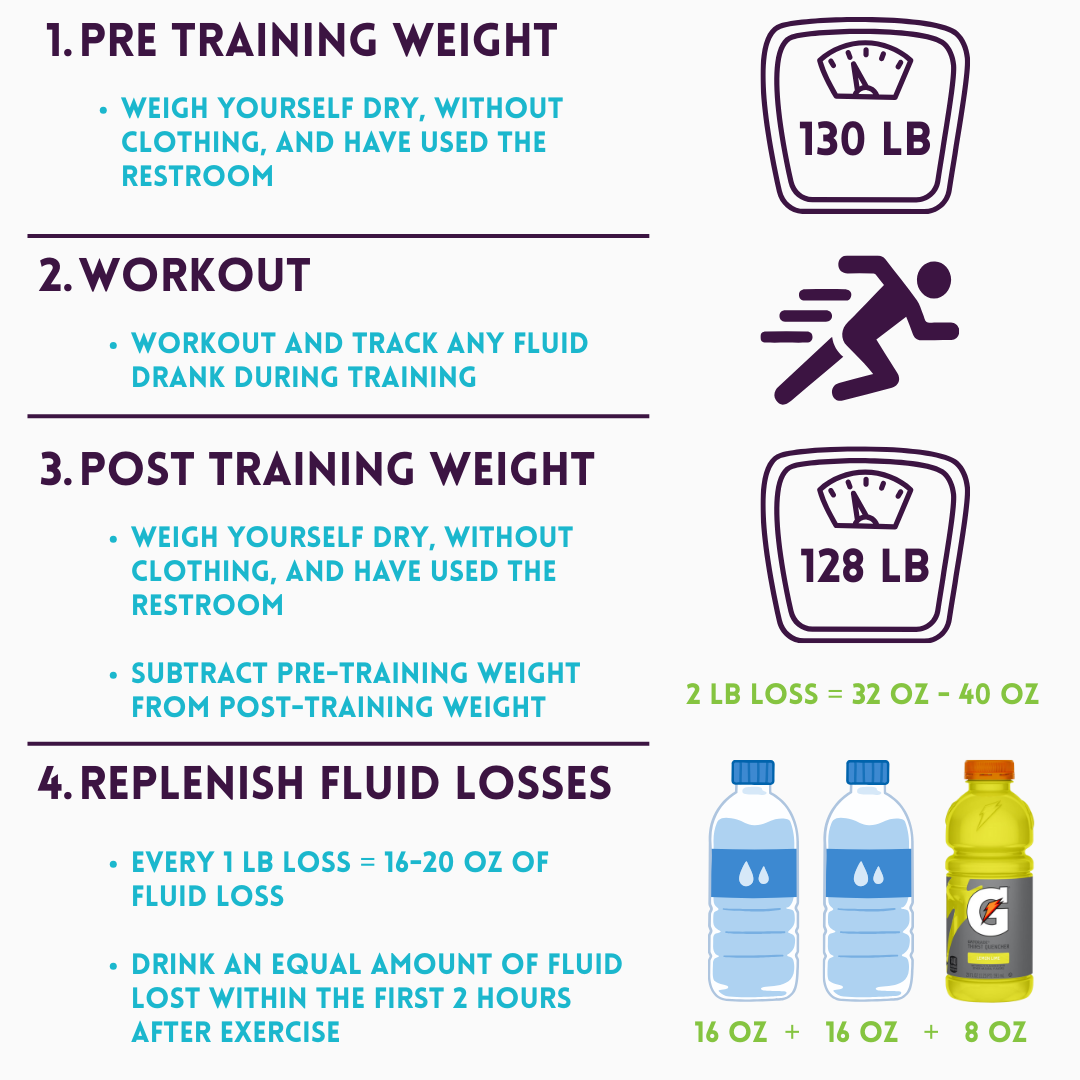
Example: (130 lb - 128 lb) x 16 = 32 oz of fluid loss and needed replacement
Increased Muscle Stiffness
As the body shifts blood from the extremities to the core during peripheral vasoconstriction, the working muscles in the legs receive less oxygen-rich blood (Kiyatkin, 2021). Less blood flow and oxygen can create a noticeable sense of muscle stiffness and may lead to early fatigue. When muscles aren't adequately warmed, they don’t contract as efficiently, which can limit power output (Gatterer et al., 2021). Many athletes interpret this as feeling heavy, sluggish, or noticing it takes longer to reach a typical pace during training. A longer, intentional dynamic workout becomes essential in cold conditions to help counteract some of these effects. Movement increases blood flow and raises muscle temperature. After a proper warm-up and a few minutes into training, an athlete may notice muscles becoming more responsive and “loose”. This can help reduce stiffness and prevent strains. Allow additional time to warm up before starting training, and a gradual increase of intensity as training begins.
Exercise-Induced Bronchoconstriction
Endurance running in the cold also impacts the respiratory system. With each breath, the body pulls in large volumes of cold, dry air. Because this air lacks warmth and moisture, bronchial epithelial cells contract. This is referred to as exercise-induced bronchoconstriction (EIB) and can make breathing noticeably harder during training sessions (Gatterer et al., 2021). Over time, repeated and prolonged exposure to high-intensity activities in the cold can increase the development of EIB. This is common among athletes, and as temperatures drop, EIB prevalence begins to rise. This may show up as chest tightness, coughing, wheezing, or mucus production, all impacting a training session. Evidence supports that warming up before training can decrease the risk of developing EIB (Gatterer et al., 2021). Emphasizing a 10-15 minute long dynamic workout gradually increases breathing to help prepare the airway for the demands of training. Wearing a mask or scarf can also humidify the air, adding warmth and moisture. Utilizing these two strategies can result in more comfortable breathing and support performance throughout the cold months.
Heart Rate Changes
In the short-term, the body responds to the cold by an increase in heart rate. This is driven by the sympathetic nervous system, the same system responsible for the body’s fight or flight response (Wang et al., 2025). When the body is cold, a message is sent to the brain that it needs to maintain a warm internal body temperature as a means of protection. To maintain warmth and support essential physiological functions, the cardiovascular system shifts into a more alert state. Heart rate rises to ensure oxygen and nutrients are properly delivered, even as blood vessels in the extremities constrict to conserve heat (Wang et al., 2025). Athletes may notice an increased effort for a pace that typically feels comfortable, partially because the body is working to balance both exercise demands and temperature regulation. Over time, long-term training in the cold can lead to adaptations. Repeated exposure over several months can result in the cardiovascular system becoming more efficient. Eventually, heart rate may decrease, reflecting improved cardiac efficiency and resilience to the cold.
How to Maximize Training in the Cold
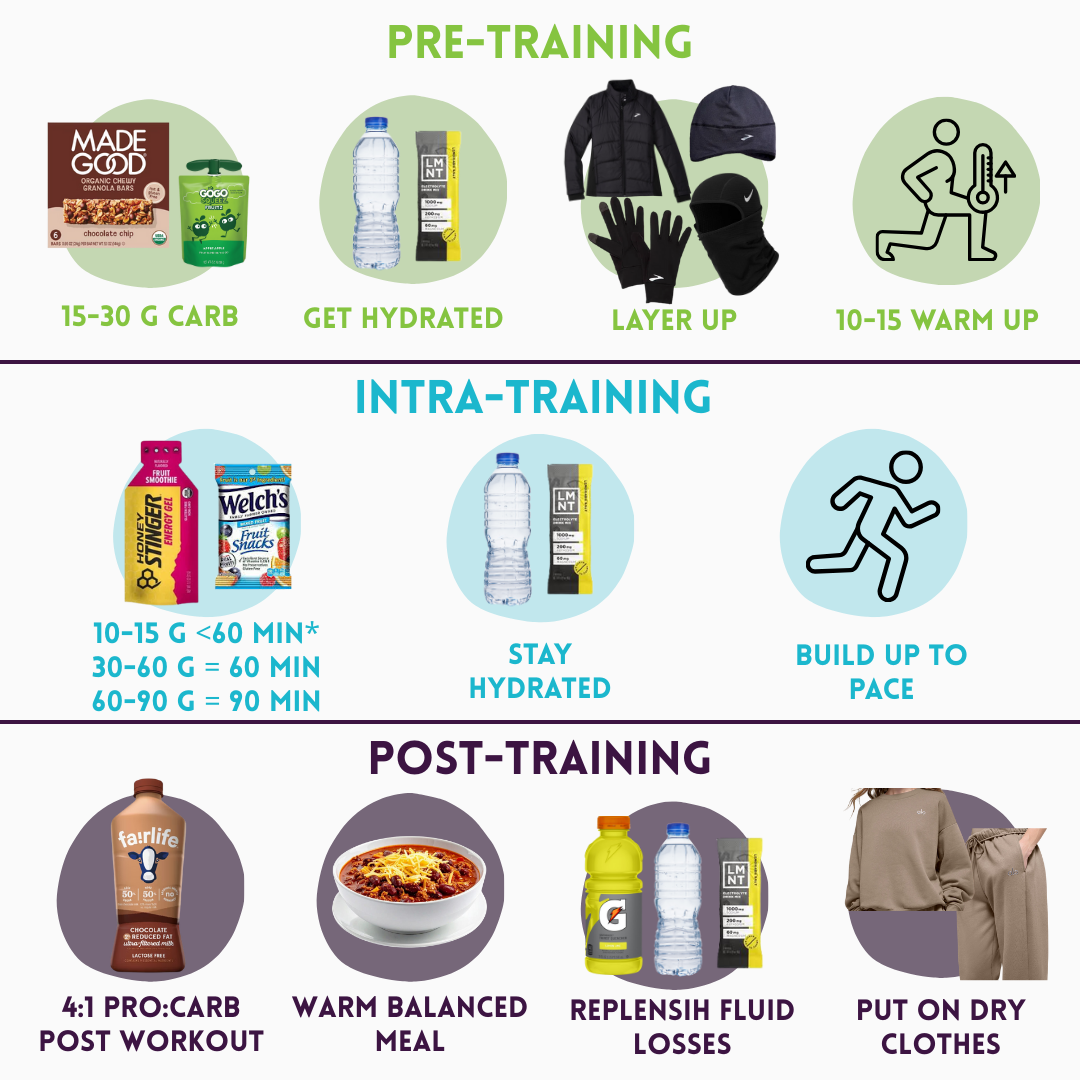
The key to training in the cold is to start warm and stay warm all while fueling adequately. Nailing down your nutrition, hydration, and injury prevention strategies can help the winter season seem shorter. Below is what this practically looks like before, during, and after training.
Before Training
Nutrition
Aim for 15-30 g of simple carbs within an hour of training
Ideas:
Liquid carbs/electrolytes in hot water
Oatmeal (add banana + syrup/honey + cinnamon)
Waffles/pancakes (add banana + syrup/honey + cinnamon)
Goal: fill and top off glycogen stores to have energy for training
Hydration
Aim for consistent fluid intake throughout the day
Reduce Injury risk:
Include a 10-15 minute dynamic workout
Layer well - choose breathable fabrics to provide insulation and wick away sweat
During Training
Nutrition
For training under 60 minutes, you have the option to fuel with 10-30g*, for training 60-90 minutes, fuel with 30-60 g, and for training longer than 90 minutes, fuel with 60-90 g.
Ideas:
Fruit snacks
Applesauce pouch
Gel
Humo+
Goal: sustain energy levels to keep intensity during training
Hydration:
Replenish sweat losses with electrolytes during training
Reduce injury risk
It's okay to start slower and let your body adjust as you build intensity
After Training
Nutrition
Eat warm foods and drinks and have carbs + protein within 60 minutes of training ending
4:1 carb: protein
Ideas:
Hot chocolate with milk
Warmed recovery drink
Chicken noodle soup + crackers
Chili
Goal: restore glycogen stores + support muscle repair
Hydration
Even if you don't feel thirsty, rehydrate after training
Reduce injury risk:
Change out of clothes soon after training ends to prevent prolonged cooling and promote comfort
The Bottom Line:
Cold weather training places extra demands on the body, resulting in faster glycogen depletion, diminished thirst cues, reduced blood flow to the extremities, increased muscle stiffness and injury risk, and increased heart rate. These physiological shifts are essential, and it means your body is responding.
By prioritizing carbohydrate intake, hydrating throughout the day, layering well, and extending your warm-up, you can maintain performance throughout the winter months. These strategies can help protect against the challenges of cold-weather training and build resilience as you enter spring training.
Learn more about winter training considerations on our Instagram!
References:
Gatterer, H., Dünnwald, T., Turner, R., Csapo, R., Schobersberger, W., Burtscher, M., Faulhaber, M., & Kennedy, M. D. (2021). Practicing sport in cold environments: Practical recommendations to improve sport performance and reduce negative health outcomes. International Journal of Environmental Research and Public Health, 18(18), 9700. https://doi.org/10.3390/ijerph18189700
Kiyatkin, E. A. (2021). Functional role of peripheral vasoconstriction: Not only thermoregulation but much more. Journal of Integrative Neuroscience, 20(3), 755–764. https://doi.org/10.31083/j.jin2003080
National Institutes of Health. (2021, October 25). What goosebumps are. https://www.nih.gov/news-events/nih-research-matters/what-goosebumps-are
University Hospitals. (2025, November). Why hydration matters. https://www.uhhospitals.org/blog/articles/2025/11/why-hydration-matters
Wang, Y., Liu, W., Han, D., Qiao, Y., Sun, W., Wang, C., Qin, X., & Xu, J. (2025). Integrated effects of cold acclimation: Physiological mechanisms, psychological adaptations, and potential applications. Frontiers in Physiology, 16, 1609348. https://doi.org/10.3389/fphys.2025.1609348
